By Jason Carillo, Production Manager · Posted July 16, 2026 · 25+ years of experience · 8-time HomeStars “Best of” winner · Serving Toronto, the GTA, Southern Ontario & cottage country
On this page
- What is crawl space encapsulation?
- What is crawl space spray foam insulation?
- Key differences: moisture, insulation, cost & longevity
- When to use encapsulation, spray foam, or both
- Cost ranges in Ontario
- Cottage & rural crawl space considerations
- How DryShield approaches your crawl space
- Frequently asked questions
Homeowners often compare encapsulation and spray foam as if they are two versions of the same job. They are not. Encapsulation manages moisture — ground water, humid air and dampness. Spray foam manages heat and air leakage — it insulates and seals. Choosing based on the wrong problem is the most common and costly mistake in a crawl space.
Key Takeaways
- Encapsulation is a moisture-control system (sealed liner, vents, drainage, humidity control); spray foam is insulation that air-seals and adds R-value.
- Only closed-cell spray foam belongs below grade — open-cell foam absorbs moisture and should never be used in a crawl space.
- Spray foam alone does not stop ground water, seepage or high humidity; if your crawl space is damp, musty or wet, you need encapsulation.
- The strongest solution for many GTA and cottage crawl spaces is encapsulation plus closed-cell foam on the walls and rim joists.

What is crawl space encapsulation?
Encapsulation turns a vented, earth-floored crawl space into a sealed, conditioned space. A reinforced 12–20 mil liner is installed across the floor and up the foundation walls, seams are taped, vents are sealed, and moisture is actively managed.
A full encapsulation system typically includes:
- A reinforced 12–20 mil liner on floor and walls, sealed at all seams
- Sealed foundation vents to block humid outdoor air
- A drainage path and sump where water intrusion is possible
- Insulation on walls and rim joists for energy efficiency
- A dehumidifier or conditioned-air supply to hold humidity in check
Encapsulation targets the whole moisture problem — ground, air and liquid water — and protects the wood framing above from rot, mould and pests. It is a waterproofing and air-quality solution first, with insulation added as part of the system.
What is crawl space spray foam insulation?
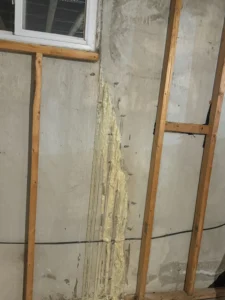
Spray foam is a two-part polyurethane insulation sprayed onto foundation walls, rim joists or the underside of the subfloor, where it expands, hardens and air-seals gaps. Its main job is to add R-value and stop air leakage — not to manage ground moisture.
Closed-cell vs. open-cell — this matters below grade:
- Closed-cell foam is dense, high R-value (roughly R-6 to R-7 per inch) and vapour-resistant. It is the only spray foam suitable for a crawl space.
- Open-cell foam is lighter, cheaper and absorbs moisture. It should never be used below grade, where ground moisture would saturate it and feed mould.
Closed-cell foam offers some resistance to water vapour, which is why it is sometimes marketed as a moisture solution. But it does not stop liquid water intrusion, does not drain a wet floor, and does not control the crawl-space humidity that drives mould. It insulates well; it does not waterproof.
Key differences: moisture, insulation, cost & longevity
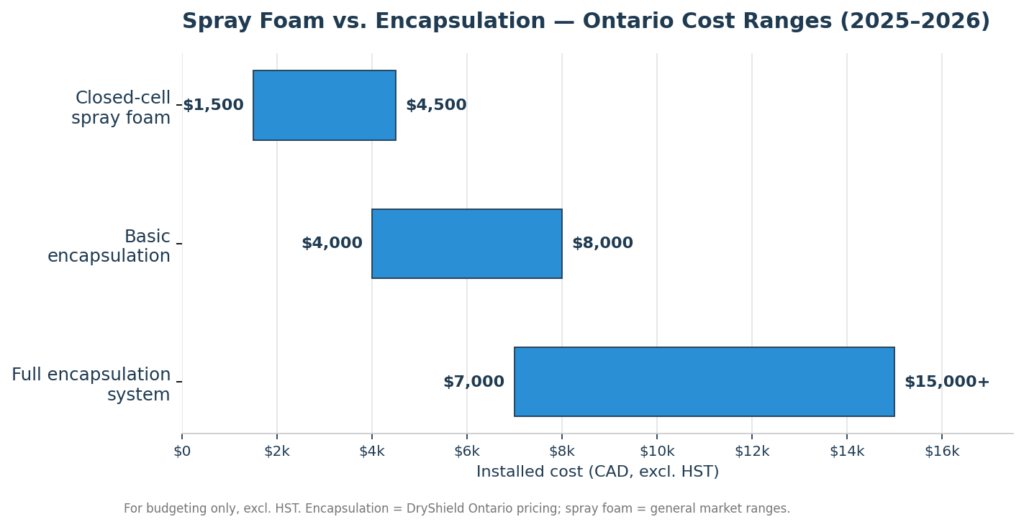
Closed-cell spray foam for a crawl space runs about
*Encapsulation figures reflect DryShield’s Ontario pricing; spray-foam figures are general market ranges (2025–2026) and exclude HST. Actual pricing depends on site conditions.
,500–$4,500, while encapsulation runs $4,000–$8,000 (basic) up to $7,000–$15,000+ (full system), before HST. *Encapsulation figures reflect DryShield’s Ontario pricing; spray-foam figures are general market ranges (2025–2026) and exclude HST. Actual pricing depends on site conditions. For a full cost breakdown by system and region, see our crawl space encapsulation cost guide.
Cottage & rural crawl space considerations
In Muskoka, Haliburton and rural Southern Ontario, spray foam alone is rarely enough. High water tables, lakeside sites, seasonal heating and poorly drained soil push moisture into the crawl space, and closed-cell foam does nothing to drain water or lower humidity. Worse, spraying foam over a damp, unmanaged crawl space can seal moisture against the framing.
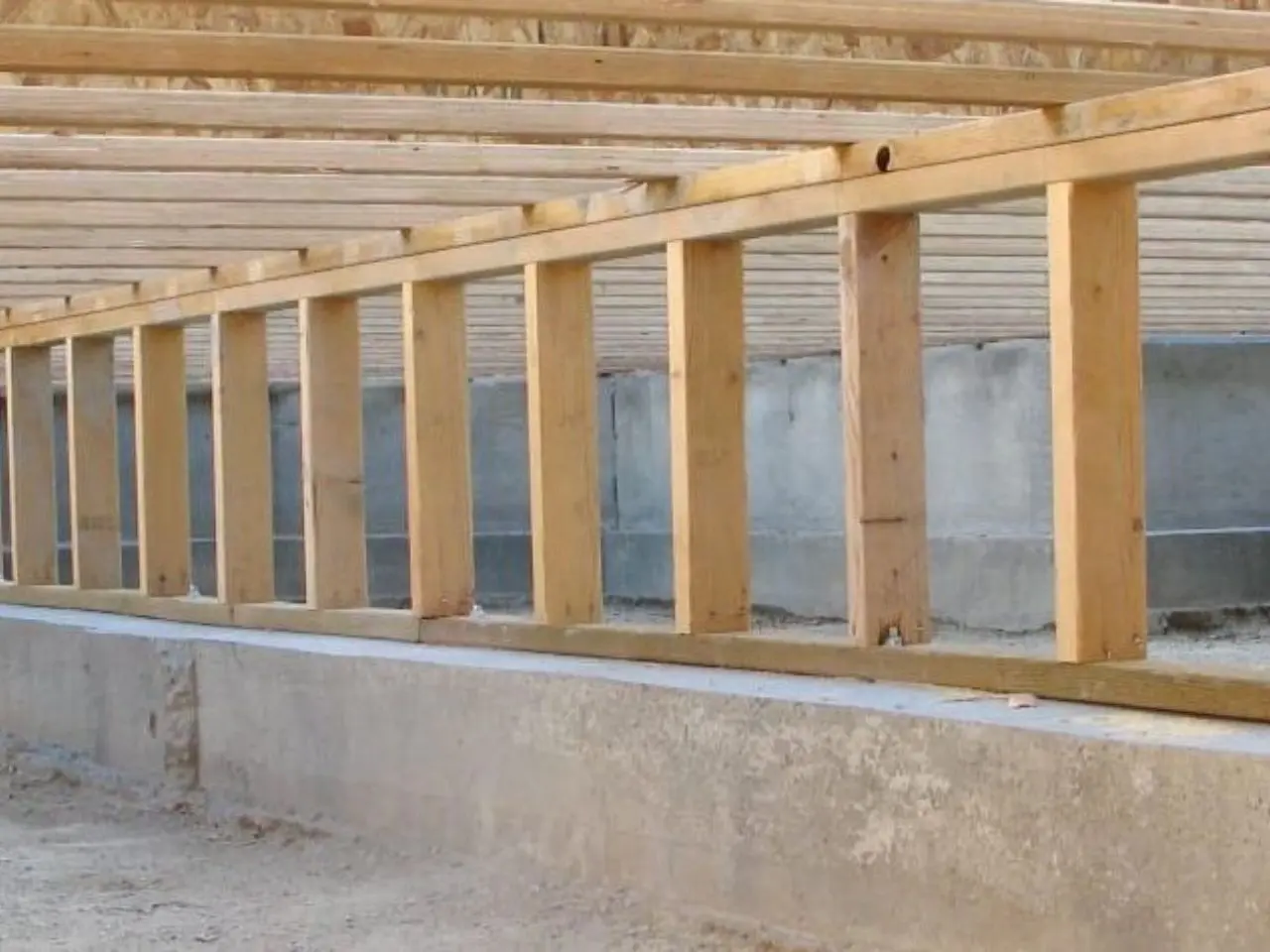
For seasonal and rural properties, the reliable approach is encapsulation with drainage and a monitored dehumidifier — which protects the structure year-round, including the months no one is there — with closed-cell foam added on the walls for insulation where it helps.
Related guide: still deciding on moisture control? See crawl space encapsulation vs. vapour barrier and our crawl space encapsulation service.
How DryShield approaches your crawl space
- Free on-site assessment — a specialist inspects moisture sources, soil, water table, mould and framing condition across the GTA and cottage country.
- Right-sized recommendation — encapsulation, insulation, or a combined system, matched to whether your crawl space has a moisture problem, an insulation problem, or both.
- Sealed, warrantied installation — reinforced liner, sealed vents, drainage and humidity control, backed by DryShield’s transferable lifetime warranty on eligible work.
DryShield is fully insured with $5M liability coverage, offers free quotes, and carries a transferable lifetime warranty on eligible work. Call 1-800-277-5411 to book a free crawl-space assessment.
Frequently asked questions
Is spray foam or encapsulation better for a crawl space?
They solve different problems, so “better” depends on your crawl space. Encapsulation is better when moisture, humidity or water are the issue — which is most damp Ontario and cottage crawl spaces. Spray foam is better purely for insulation and air sealing. For a dry, energy-efficient result, many homes need encapsulation with closed-cell foam added.
Can spray foam be used instead of a vapour barrier in a crawl space?
Closed-cell spray foam resists water vapour, but it is not a substitute for a full encapsulation system. It does not stop liquid water, drain a wet floor, or control humidity. In a damp crawl space, foam alone can trap moisture against the framing. A sealed liner with drainage and a dehumidifier manages moisture that foam cannot.
Should I use open-cell or closed-cell spray foam in a crawl space?
Only closed-cell spray foam should be used in a crawl space. Closed-cell foam is dense, high in R-value and vapour-resistant, so it suits below-grade conditions. Open-cell foam absorbs moisture and should never be used below grade, where ground dampness would saturate it and feed mould and wood rot.
How much does spray foam cost for a crawl space in Ontario?
Closed-cell spray foam for a crawl space generally runs about $1,500 to $4,500, depending on size, foam thickness and access — roughly $1.50 to $4.50 per square foot before HST. That covers insulation and air sealing only, not a moisture system. A free assessment gives a firm price for your space.
Does spray foam stop crawl space moisture and mould?
Not on its own. Closed-cell foam slows vapour movement, but it does not stop ground water, seepage or high humidity, and it does not remove existing moisture. Mould needs humidity control and a dry surface, which come from encapsulation with a dehumidifier — not from insulation alone.
Can you combine encapsulation and spray foam?
Yes, and it is often the strongest system. Encapsulation manages moisture with a sealed liner, drainage and humidity control, while closed-cell foam on the foundation walls and rim joists adds insulation and air sealing. Moisture is handled first; insulation is added on top for warmer floors and lower energy bills.
Does encapsulation include insulation?
A full encapsulation system typically includes insulation on the walls and rim joists along with the liner, sealed vents, drainage and humidity control. The liner itself is a moisture barrier, not an insulator, so insulation — often closed-cell foam or rigid board — is added as part of the system for energy efficiency.
Will spray foam make my floors warmer?
Yes. Closed-cell foam on the crawl-space walls and rim joists reduces heat loss and air leakage, so the floors above feel warmer and your furnace works less. For the biggest comfort gain, pair it with encapsulation so the space stays dry — damp insulation loses effectiveness and can harbour mould.
Is spray foam safe in a crawl space?
Properly installed closed-cell spray foam is safe and durable in a crawl space once cured. Problems arise when open-cell foam is used below grade, when foam is sprayed over a wet or mouldy surface, or when it is applied without addressing moisture first. That is why moisture control should come before insulation.
How long do spray foam and encapsulation last?
Closed-cell spray foam can last decades once applied. A quality encapsulation system generally lasts 15–20+ years, with premium reinforced liners lasting longer. Both are long-term investments; the difference is what they protect — foam preserves energy efficiency, while encapsulation preserves the structure by keeping it dry.
Do cottage crawl spaces need encapsulation or spray foam?
Cottage and rural crawl spaces in Muskoka, Haliburton and rural Ontario usually need encapsulation first. High water tables, lakeside sites and seasonal heating drive moisture and condensation that spray foam cannot manage. Closed-cell foam can be added for insulation, but a sealed, drained, humidity-controlled space is what protects an unoccupied cottage year-round.
Which should I do first if I need both?
Always manage moisture first. Encapsulate the crawl space — seal the liner, close vents, add drainage and humidity control — then apply closed-cell foam for insulation. Insulating before moisture is controlled traps dampness against the framing, so the order matters as much as the choice of system.